Commercial Water Damage in Auburn, GA
A leak in a shop or warehouse costs money every day the doors stay closed. The response team extracts the water, dries the space in phases around business hours and keeps the paperwork an owner, a landlord and an adjuster all need.
(888) 532-4616Water in the shop or suite- Phased drying plans
- Carpet tile removed
- Logs for the claim
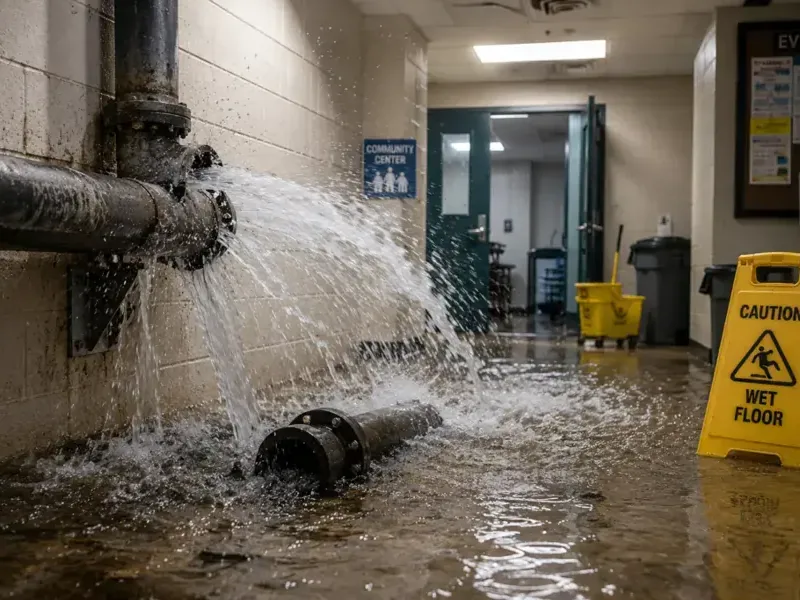
First steps for commercial water damage cleanup
- 1Secure the space. Shut off the source, switch off power to wet areas and move inventory and files above the water.
- 2Extract fast. The extraction crew removes standing water from floors and pulls carpet tile or pad that is holding moisture.
- 3Plan around business. The drying team sets zones so dry sections can reopen while equipment keeps running in the others.
- 4Dry and document. Dehumidifiers and air movers run with logged readings, and the file is built for the owner, landlord and insurer.
How commercial water damage cleanup gets handled here
Two dry-outs can look the same on the first afternoon. The readings, the order of the work and the paper trail are what set a complete one apart.
Around-the-clock response
Commercial losses do not wait for Monday. The response team works nights, weekends and holidays so a Friday evening leak does not sit all weekend.
IICRC S500 drying standard
Large spaces are dried under the S500 standard with sized dehumidifiers and readings by zone, so tenants know when each space is cleared.
Documentation for the claim
Photos, moisture logs and equipment records are organized for a business interruption claim, a landlord and an adjuster.
Local building know-how
Commercial stock runs from historic brick storefronts and railroad warehouses downtown to industrial land in the north, plus the Atlanta Highway corridor and the planned Town Center, and each dries differently.
What does commercial water damage cleanup cost in Auburn, GA?
Commercial water damage runs $3,000 to $8,000 for one suite or storefront. Several suites or a floor run $8,000 to $25,000, and a warehouse or large loss reaches $25,000 to $75,000+.
Four things move the number: the water category, how many square feet got wet, the material class and how soon drying began. The water damage cost calculator gives a planning range, and the firm figure comes after the walkthrough.
One suite or storefront
$3,000 to $8,000- Water extracted
- Dried around opening times
- Daily moisture logs
Several suites or a floor
$8,000 to $25,000- Carpet tile and base removed
- Large dehumidifiers set
- Records for claims
Warehouse or large loss
$25,000 to $75,000+- Zones sealed off
- Desiccant drying
- Work phased by area
From first reading to dry: commercial water damage cleanup
- 1
Assess the loss
The tech who does the walkthrough checks floors, walls, ceilings and stock, and marks wet zones on a plan.
- 2
Extract and remove
Water is pulled, wet carpet tile and base are removed and flood cuts are made where walls wicked.
- 3
Dry by zone
Dehumidifiers and air movers run by zone so the dry sections can return to use sooner.
- 4
Verify and report
Final readings and a summary give the owner and the insurer a clear close.
A commercial loss is a clock running on rent, payroll and lost sales. The restoration team treats time as part of the scope, setting up in zones so dry areas can reopen while the rest of the building is still drying. Owners can read about water extraction for the first step.
Buildings that need different plans
- Historic brick storefronts with old floors and plaster
- Railroad era warehouses with large open floors
- Industrial buildings on the north side of town
- Shops and offices along Atlanta Highway
- Small commercial blocks planned for Town Center
- Meeting halls and rental venues used for events
Where commercial water loss tends to start
Atlanta Highway, which is US Route 29 and State Route 8, is the main commercial corridor and carries about 19,500 vehicle trips a day, so storefronts there cannot stay shut for long. Mount Moriah Road and Etheridge Road lead to the industrial zones and northern neighborhoods. Roof leaks, burst pipes and storm runoff are the usual causes, and big open buildings can hide water along floor edges and wall bases.
Water in the shop or warehouse? Talk with a technician about a phased drying plan.
Talk to dispatch about commercial water damage cleanup: (888) 532-4616Permits, inspections and the rebuild
Auburn requires building permits for most alterations and renovations, and inspections are done by a city-contracted third-party inspector. The drying logs help show when the structure was ready for that rebuild. Owners and landlords can start with the cost calculator to frame the scope, then confirm details on site.
Covering Auburn, GA and the roads around it
The restoration team covers all of ZIP 30011, from the downtown storefronts and the historic district to the Town Center, Harmony and Trinity Station, plus the homes and businesses along Atlanta Highway and Mount Moriah Road.
View the full service areaCommercial Water Damage: what homeowners ask
Can the business stay open during drying?
Often partly. The drying team works in zones, sealing off wet areas while dry sections keep operating. The plan depends on how much of the space is wet and on safety.
What gets removed in an office or shop?
Wet carpet tile, base trim, ceiling tile and soaked drywall come out first. Hard floors and framing are usually dried in place, and inventory is moved before work starts.
Who handles the landlord and the tenant?
The documentation is built for both. Photos, readings and equipment records are organized so each party and the adjuster can see what was wet and what was done.
Does insurance cover commercial water loss?
Commercial policies differ on sudden versus gradual losses and on lost income. Your insurer decides, and moisture logs, photos and dated records make the claim easier to support.
How long does a commercial dry-out take?
Many suites dry in three to five days once water is out. Warehouses and dense materials take longer, and desiccant units may be added for large concrete floors.
Can warehouse inventory be saved?
Sometimes. Items are moved off wet floors early, and anything porous that touched contaminated water is usually discarded. Photos before disposal support the claim. See structural drying for the building.
Water in the building? Get a phased drying plan started
Tell the response team how the space is used and which areas are wet, and the plan fits around that.