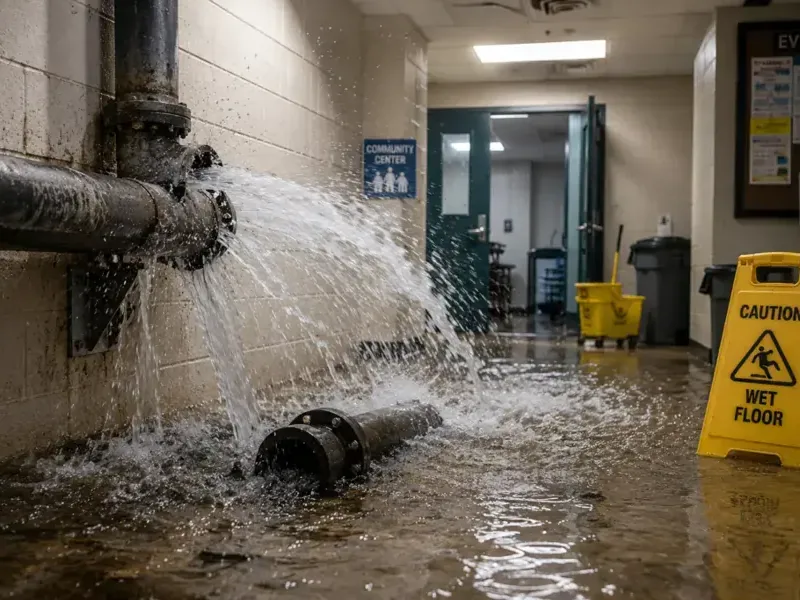
A commercial water loss spreads differently from a home leak. In December 2022 a fire alarm set off the sprinkler system and sprayed water over the front of businesses in the Monroe Pavilion, a reminder of how fast one event can reach many tenants.
Key takeaways
- Commercial losses are wider, so stopping the source and protecting stock come first.
- A single sprinkler discharge can wet the fronts of several businesses at once.
- Brick and older framing in historic buildings dry slowly and need readings before anything is sealed.
- Never close a sprinkler valve unless the fire department or a fire protection contractor says it is safe.
- Phased drying can keep part of a business open while the rest is dried.
How a commercial loss differs from a home loss
A home leak usually involves one family and a few rooms. A commercial water damage loss involves stock, customers, shared walls and sometimes several tenants under one roof.
Downtime matters as much as drying. Every day a doorway stays closed is a day without sales, so the plan balances speed with care.
Lease terms can decide who arranges the work, so tenants and owners should know them before a loss.
- Larger floor areas mean larger pumps and more drying equipment.
- Stock, files and fixtures add items that need to be moved and protected.
- Shared walls and ceilings can pass water from one tenant to another.
- Landlords, tenants and managers each need clear information.
A sprinkler discharge: the Monroe Pavilion example
In December 2022 a fire alarm set off the sprinkler system and sprayed water over the front of businesses in the Monroe Pavilion.
The water came from the sprinkler discharge itself, a reminder that a loss can start with a trigger rather than a leak.
A sprinkler system moves a large volume of water through a building in a short time, which is why the opening stretch matters for stock and fixtures.
Sprinkler heads keep discharging until the system is shut down, and the water runs through ceiling tiles and down walls. Tiles that have been wet usually sag and are replaced.
First steps after a discharge
- Contact the fire department if it is not already on scene.
- Keep people out of wet areas until power is checked.
- Do not close a sprinkler valve unless the fire department or a fire protection contractor says it is safe.
- Lift stock, files and electronics above the water.
- Photograph each tenant space before anything is moved.
Mill buildings and brick storefronts
Monroe Cotton Mills was founded in 1895 and made textiles for more than 90 years. A local family bought the shuttered mill from Avondale Mills in 2008 to save it from demolition.
Both old mills no longer make cotton goods and now house antique markets, event space and other retail, and the Factory at Walton Mill is an event venue in the former Walton Cotton Mill Company building.
The city also has nine historic districts and nine buildings on the National Register of Historic Places, including the Walton County Courthouse.
A mill with tall ceilings and open floors is a large volume to dry, and the plan usually works zone by zone.
Drying heavy and older materials
Structural drying in a mill or a historic storefront is planned around the materials found there, not a standard template.
- Brick and mortar hold water longer than drywall does.
- Old wood floors and beams need readings before anything is sealed.
- Antique markets and event venues hold furniture, textiles and paper that need quick triage.
- Tall ceilings and open floors need drying equipment set at several heights.
- Floors above and below the wet area are checked, since water travels through older floors.
Hospitals, plants and other large floors
Piedmont Walton Hospital on West Spring Street is a 77-bed acute care hospital. Larger employers include Hitachi (now Astemo), the Walmart Distribution Center, Leggett & Platt and Tucker Door & Trim.
Large buildings bring large floors, electrical panels and equipment that cannot simply be moved. Each needs a plan agreed with the facility team before the first pump starts.
A medical or care building brings extra rules for air handling and patient access, so those decisions belong to the facility team first.
- Medical buildings: coordinate access and infection control with facility managers.
- Plants and distribution centers: protect panels and machinery, and map the wet floor first.
- Retail and offices: protect stock, records and computers.
- Venues: protect floors, linens and decor before the next booking.

Triage for stock, records and equipment
What is inside a business is often worth more than the building finish. Quick sorting saves items that would otherwise be lost.
- Paper and records: lift them out of the water and keep wet files together for quick drying.
- Electronics: leave them off until they have been checked.
- Textiles and linens: separate them and wash or discard them.
- Packaged goods: check the packaging and set aside anything that touched water.
- Fixtures and shelving: dry them in place or lift them off the floor.
First steps for a business owner
Whatever the building, the first decisions are the same. Stop the source, make the space safe and protect what can be saved.
- Shut off the water supply to the affected area, or have the right person do it.
- Switch off power to wet areas if it is safe to reach the panel.
- Move stock, records and electronics up and out of the water.
- Tell the landlord or property manager right away.
- Photograph and list damaged items before cleanup.
- Note the dates and hours of any closure.
- Ask the landlord who holds the building shutoff keys and the sprinkler contacts.
Staying open while drying
A good plan rarely shuts a whole business down. Drying can be phased so that the wet area is isolated and the rest of the building keeps operating.
The full range of commercial work is outlined under commercial water damage restoration.
In a multi-tenant building, tenants should coordinate with the landlord or property manager so that access, power and equipment are arranged once for the whole building.
- Plastic containment keeps wet and dry areas apart.
- Work can run after closing time, on nights and weekends.
- Equipment is placed to leave aisles and exits clear.
- A daily update tells the owner what has dried and what remains.
- Customers are told which entrance to use and which areas are closed.