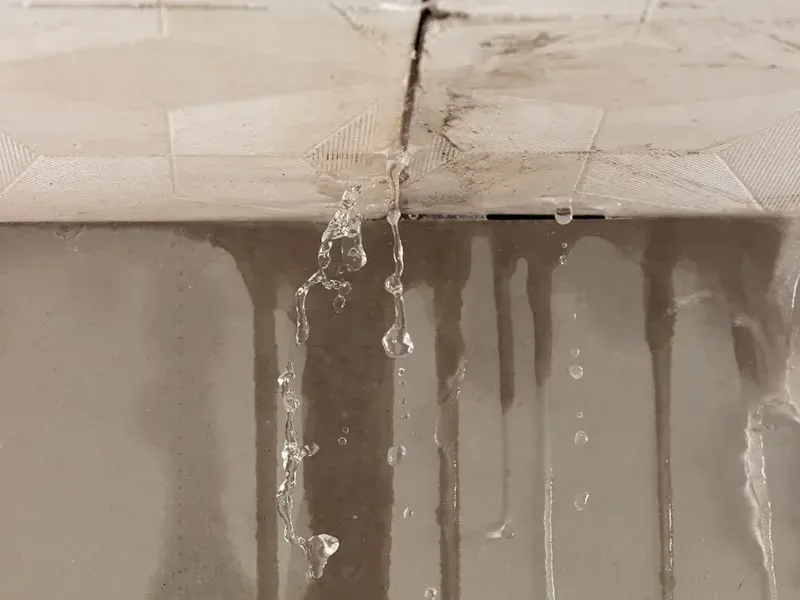
Jefferson has been adding houses quickly. In 2024 the city issued 215 residential building permits worth $35.6 million, all for single-family homes. Mallard's Landing, one of the subdivisions with Jefferson addresses, offers both ranch and two story plans.
Key takeaways
- A stain shows where water ended up, not where it started.
- In a ranch plan the roof, vents and attic come first, while in a two story plan an upstairs bath is a suspect too.
- A stain that grows after rain points to the roof, and one that grows when a fixture runs points to plumbing.
- A bulging or sagging ceiling is holding water and should be treated as urgent.
- Wet insulation and drywall are dried or removed before the ceiling is painted.
Why a ceiling stain looks the same but starts differently
A brown ring on a ceiling says water is above that spot, not where it started. Water runs along framing, drywall seams and insulation before it shows.
That is why ceiling leak water damage work starts with finding the path of the water, not just drying the visible stain.
The shape of the stain gives early clues, even before anyone opens the ceiling.
A stain can also be older than it looks. A faint brown mark that has dried is a record of a past leak, and a fresh one is damp to the touch.
- A round ring usually sits under the source.
- A long streak often follows a joist or a duct.
- A row of spots can mean water running along a pipe.
- A bubble in the paint means moisture is trapped behind it.
Ranch plans: the roof and attic come first
In a single story plan nothing sits above the ceiling except the attic and the roof. That narrows the list of suspects, but the leak can still travel a long way inside the attic before it drops through.
Where leaks start
- Flashing around vent pipes, chimneys and skylights.
- Roof valleys, where two slopes send water into one channel.
- Bath fan ducts that run through a cold attic and drip.
- The condensate pan under an attic air handler.
How the leak shows
In a ranch plan the stain often appears in a hallway, a bedroom corner or beside a bathroom, wherever the water finally finds a gap in the drywall.
Insulation soaks up the first water and hides the problem, so a stain can show up days after the rain that caused it.
Two story plans: an upstairs bath is a suspect too
A two story plan adds a second set of suspects. The ceiling below an upstairs bathroom or laundry can stain even when the roof is sound.
Upstairs sources
- A tub or shower that overflows or leaks at the drain.
- A toilet supply connection or a failed seal.
- A washer hose in an upstairs laundry.
- The roof and attic above the second floor.
What the leak touches
Water from an upstairs bath runs down inside the wall, soaks the ceiling below and can reach light fixtures. A restoration crew checks all three before any drying starts.
A quick way to tell roof water from plumbing water
A few observations narrow the cause before anyone climbs a ladder. Roof leak water damage shows up with the weather, while plumbing leaks follow use.
Georgia has seen regional storm events such as Hurricane Helene in September 2024 and the remnants of Tropical Storm Fred in August 2021. They are a reminder that roofs of every age take wind driven rain.
- The stain appears or grows only during or after rain: the roof or a vent is the likely source.
- The stain grows when a shower, toilet or washer is used: plumbing above is the likely source.
- The stain sits near a bath fan or an attic air handler: a duct or a condensate drain is the likely source.
- The stain appears in dry weather with nothing running: a supply pipe may be weeping.
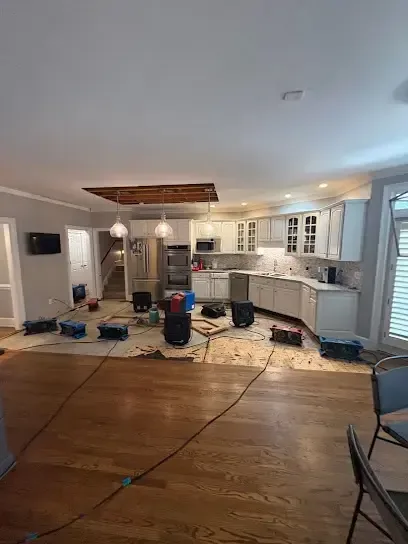
What the drying crew does with a wet ceiling
The crew starts with moisture readings on the ceiling, the insulation above it and the walls beside it. A small inspection opening shows whether the cavity is wet.
The full process for ceilings is laid out under ceiling leak water damage restoration.
A ceiling that has been wet for days may be opened to the framing so that the cavity can be dried from both sides.
- Wet insulation is removed because it holds water against the drywall.
- Sagging or stained-through drywall is cut out.
- Drywall that is only damp may be saved with drying equipment.
- Light fixtures and wiring in the wet area are checked before power is restored.
- Equipment stays until the readings match dry framing.
Temporary steps while waiting for repairs
A leaking ceiling is an electrical and a structural concern as well as a water problem. A few quick actions protect people and belongings until the cause is found.
- Switch off the breaker for any light fixture or fan in the wet area.
- Move furniture and rugs out from under the stain.
- Place a bucket under a drip and poke no holes unless advised.
- Keep children and pets out from under a bulging ceiling.
- Photograph the stain, the room and any wet insulation you can see from the hatch.
Subdivisions with Jefferson addresses: what to watch early on
Heritage at Jefferson, Mallard's Landing, Hampton Ridge, Red Bird Manor, Jackson Landing, Reserve at Gum Springs and Jefferson Downs are subdivisions with Jefferson addresses that sell newer homes. Mallard's Landing, for one, offers both ranch and two story plans.
Newer does not mean leak proof. A fresh roof, a new air handler or a brand new bath still has joints and seals that can fail.
- Mark the edge of a stain with a pencil and a date to track whether it grows.
- Photograph the stain, the attic hatch and any wet insulation.
- Check bath fan ducts and attic air handlers once a year.
- Keep plumbing and roofing contacts together so help is easy to reach.