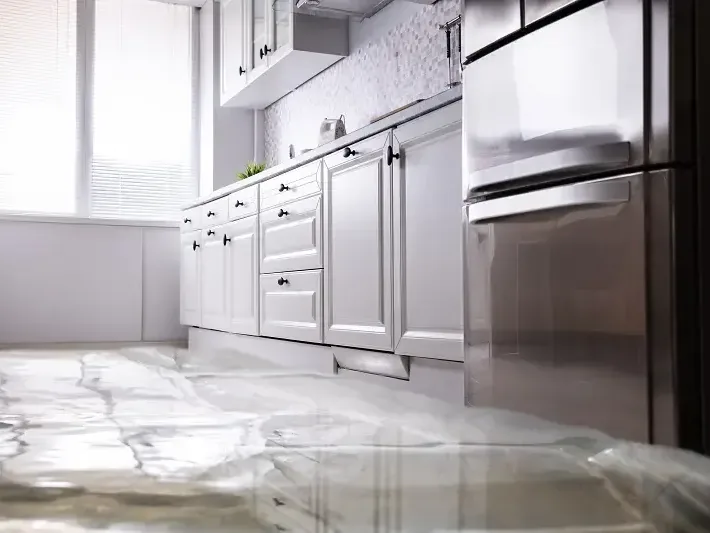
Most Auburn housing, about 80 percent of units, is detached single-family homes. Townhome communities work differently, because shared walls and stacked floors give a leaking appliance more places to send water.
Key takeaways
- In a townhome a leak can go down through the floor and sideways through a shared wall.
- Washer hoses, dishwasher connections and refrigerator ice maker tubes are the usual sources.
- Closing the appliance's shutoff valve stops new water, but the water already spilled still has to be removed.
- Telling a neighbor early limits damage on both sides of the wall.
- Dated photos and moisture readings keep the record clear for everyone involved.
Why a townhome leak does not stay in one room
In a detached house, water from a dishwasher usually stays within the kitchen and the floor below it. In a townhome the same water can run under a wall into the next unit or soak through to the floor beneath.
That is why appliance leak cleanup in an attached home starts with finding every place the water went, not only the spot where the appliance sits.
Townhome walls separate units, but they are not watertight. Water moves through gaps around pipes, along the bottom of a wall and through the subfloor.
Because the units sit so close together, a neighbor's stain or smell is often the first sign that something is wrong. Listening to that report early saves a lot of repair.
- A neighbor reports a stain, a smell or damp baseboards.
- Paint peels or baseboards swell near the kitchen or laundry.
- A floor feels soft or spongy near an appliance.
- The water bill rises with no change in how the home is used.
The usual suspects in a kitchen and laundry
Appliance leaks tend to start small and run for a while before anyone notices. The hidden ones cause the worst damage.
Kitchen
- The dishwasher supply connection and drain hose.
- The refrigerator ice maker supply tube behind the unit.
- Sink drain traps and supply connections under the cabinet.
- A disposal or sink drain that loosens and seeps into the cabinet base.
Laundry
- Washer supply hoses, which carry full pressure whenever the valves are open.
- The drain standpipe, which can overflow when the washer empties faster than it drains.
- A pan or floor drain that is blocked when it is needed.
- A washer that creeps out of place and kinks a hose.
Townhome communities in Auburn
Townes of Auburn is a development of 398 townhomes.
Harmony is a mixed-density community with single-family homes and townhomes at the new Town Center, and Trinity Station is a townhouse subdivision of 104 lots whose final plat was on the city's April 2026 workshop agenda.
Attached units share walls and floors, so one leaking appliance can reach a neighbor. Local pages on water damage restoration in Auburn cover how the work is handled.
More shared walls means more places where one household's leak can become another household's problem.
- Water moves down through the floor into the unit below.
- Water moves sideways along a shared wall and under baseboards.
- Water follows pipe and duct openings between floors.
First steps when an appliance lets go
Stop the water first, then the spread. Towels alone rarely keep up with a supply hose that is still open.
If water has already reached another unit, tell that household right away and share photos and readings. Fast, friendly contact keeps a leak from becoming a long argument.
- Close the shutoff valve for that appliance, or the main valve if it will not close.
- Unplug the appliance only if the floor around it is dry, otherwise switch off the breaker.
- Move rugs, boxes and small furniture out of the wet area.
- Photograph the water, the appliance and the wall before anything is moved.
- Tell the neighbor or the property manager if the wall is shared.
- Arrange extraction promptly, because water keeps traveling into the subfloor.
- Leave appliance doors and cabinet doors open so the area can be seen and checked.
- Keep the area closed to children until the floor is dry and the power is safe.
What the restoration team dries
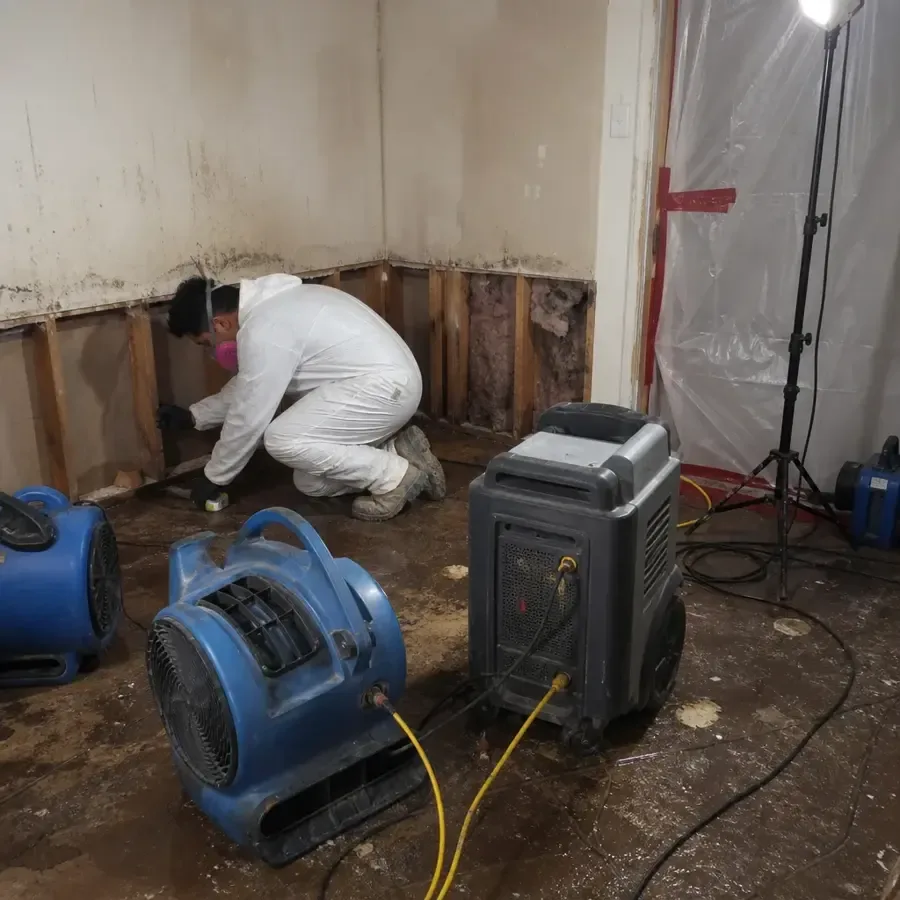
The team removes standing water first, then checks the floor, the cabinet bases and the walls with moisture readings.
Where access to the next unit is allowed, drying equipment is placed so that both sides of a shared wall dry together.
The unit with the appliance
- Flooring is lifted where water has gone under it.
- Cabinet toe kicks and baseboards are pulled so the wall base can dry.
- Drywall is cut back if the readings stay high.
- Insulation inside wet walls is removed because it holds water.
The unit below or beside
If water reached the unit below, ceiling leak water damage cleanup is needed there too. A neighbor's wall may need readings even when it looks fine.
Working with a neighbor, an association or a property manager
A leak between units involves more than one household, and a little coordination saves time. The restoration team can only dry a shared wall if both sides are open to it.
- Share dated photos and moisture readings with the other household.
- Agree who will call the plumber and who will arrange drying.
- Allow access for readings in the other unit, even if it looks dry.
- Keep a written log of who was told, and when.
Prevention that costs little
Most appliance leaks give a warning before they fail. A few habits catch them early, and the full cleanup process is outlined under appliance leak water damage restoration.
Appliances age, and an older washer or dishwasher is more likely to leak. Planning a replacement before it fails is cheaper than a cleanup.
- Replace washer hoses that bulge, crack or rust at the fitting.
- Use braided metal hoses and keep the valves accessible.
- Look behind the refrigerator and under the dishwasher a few times a year.
- Do not run the washer or dishwasher while no one is home.
- Keep a drain pan under the washer if it sits above living space.